Tarifa Total Eclipse
Where the umbra first touches Europe, on the southern tip of Spain.
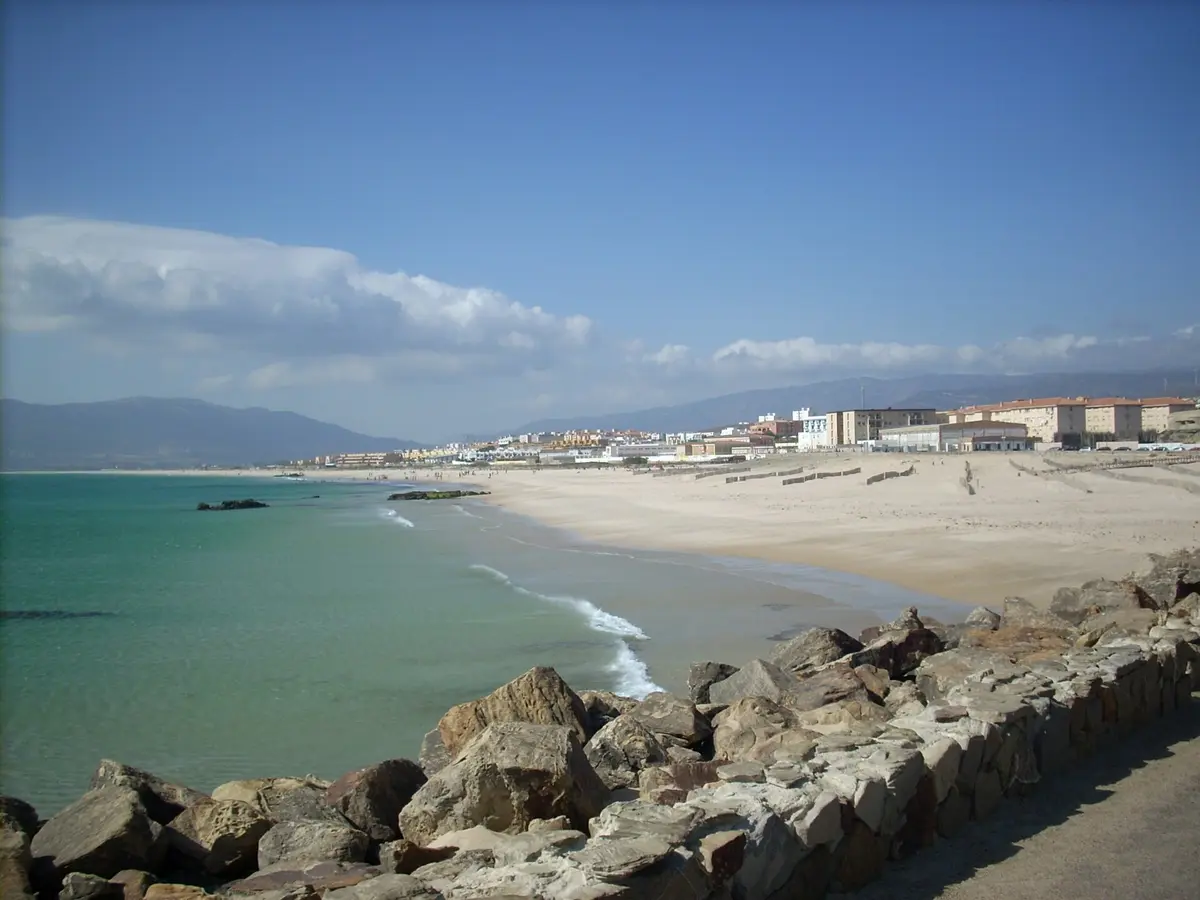
Europe’s share of this eclipse begins at the bottom of Spain. After sweeping in across the open Atlantic, the Moon’s umbra reaches the coast of Andalusia, and Tarifa, the southernmost point of continental Europe, gets 4 minutes 38 seconds of totality, from 10:45:10 to 10:49:48 local time (CEST, UTC+2) on Monday 2 August 2027.
That is the longest totality anywhere on the Spanish mainland, and 2nd of the 43 places in Spain in our dataset; only Ceuta, across the Strait, gets more. The central line runs over the sea 35 km to the south, and the northern edge of the path is 84 km away. Four and a half minutes is a serious eclipse by any standard: longer than anything North America saw in 2024, and about two and a half times what northern Spain gets on 12 August 2026.
There is one thing to plan around, and it is the opposite of the Egyptian problem. Here the Sun is only 38° above the horizon and almost due east, at an azimuth of 95°. In Luxor the Sun is 82° up and nothing on the ground can block it. In Tarifa a building close by, a parasol or a bank of low cloud over the Strait can. Choosing your spot matters here.
The eclipse from Tarifa, minute by minute
All times are CEST (UTC+2) on Monday 2 August 2027.
- 09:40 First contact The Moon takes its first bite out of the Sun’s edge. Nothing is visible without eclipse glasses. Put them on now.
- 10:45:10 Totality begins: second contact The last sliver breaks into Baily’s beads, then the diamond ring. When the ring goes out, glasses off.
- 10:47:28 Mid-eclipse Deepest darkness. The corona surrounds a black Sun 38° above the horizon; look for planets and the horizon glow.
- 10:49:48 Totality ends: third contact A second diamond ring flares on the opposite limb. Glasses back on the instant it appears.
- 12:00 Fourth contact The Moon leaves the Sun’s disc and the eclipse is over.
| Eclipse type | Total |
|---|---|
| Duration of totality | 4m 38s |
| Maximum obscuration | 100% |
| Eclipse magnitude | 1.025 |
| Sun’s altitude at maximum | 38° |
| Sun’s azimuth at maximum | 95° |
| Mid-eclipse (UTC) | 08:47:28 |
Tarifa in numbers
Every contact to the second, where the town sits in the path, and how often early August has been clear here.
| Partial eclipse begins | 09:40:55 |
|---|---|
| Totality begins | 10:45:10 |
| Mid-eclipse | 10:47:28 |
| Totality ends | 10:49:48 |
| Duration of totality | 4m 38s |
| Partial eclipse ends | 12:00:44 |
| Distance to the central line | 35 km |
| Distance to the nearest edge (northern limit) | 84 km |
| Rank by duration | 2nd of 43 places in Spain in our dataset |
Chance of a clear sky
Period: 26 July to 9 August of every year from 2001 to 2024. The bars show the daily mean cloud cover on 2 August of each year: the taller the bar, the more cloud. On 18 of those 24 days the sky was almost clear.
under 20% 20 to 50% 50% or more
Source: NASA POWER (CERES SYN1deg satellite data), daily mean cloud amount for the 1° grid cell (about 100 km) around Tarifa. It is an average over the whole day and a large area, so it cannot see a sea fog on one beach or the cloud at the hour of the eclipse. It is climatology, not a forecast.
Tarifa on the eclipse map
The gold band is the path of totality. Click anywhere to test a spot of your own; a few kilometres genuinely matters.
Where Europe meets the shadow
Tarifa sits on a spit of land pointing into the Strait of Gibraltar, with the Atlantic on one side and the Mediterranean on the other. From the causeway to the Isla de las Palomas you are at the southern tip of continental Europe, and Africa is 14 km away across the water.
That geography produces a detail worth savouring. The umbra crosses the Strait so fast that Tarifa and Tangier are eclipsed at almost the same instant. Tarifa’s mid-eclipse is at 10:47:28 CEST; Tangier’s is at 09:47:07 Moroccan time (UTC+1), one hour earlier by the clock and 21 seconds earlier in reality. Two continents, two time zones, one shadow.
At totality the Sun stands over the eastern mouth of the Strait: open water, with the Algeciras side on your left and the coast around Ceuta on your right. The Rock of Gibraltar lies well to the left of the Sun from here.
What the town is otherwise known for
- Wind. Tarifa is Europe’s kitesurfing and windsurfing capital, because the Strait funnels air between two seas. The levante blows from the east, the poniente from the west, and both matter to your eclipse.
- The Castillo de Guzmán, a tenth-century fortress above the harbour, and a compact walled old town of white lanes.
- Whales and dolphins. The Strait is one of the best places in Europe to see dolphins, pilot whales and, with luck, orcas in summer.
- Baelo Claudia, a remarkably complete Roman town on the beach at Bolonia, with a forum, a theatre and the tanks where the Romans made fish sauce.
Where to watch in Tarifa
With the Sun 38° up, neither the hills nor low buildings hide it. The hills behind Los Lances rise only a few degrees above the horizon from the beach. What makes a good spot here is space, parking, shade for more than two hours of partial phases, shelter from the wind and a plan for leaving. Face east, a touch south.
Los Lances beach
Seven kilometres of sand between the town and Valdevaqueros. There is room for everyone, the view east is open, and you can walk there from the old town at the southern end. It is the natural choice for big groups and for anyone staying in town. Crowd risk is high on the town stretch and low in the middle of the beach. In a strong levante the sand flies, so protect cameras and eyes, and weigh down anything on a tripod.
The Alameda, the harbour and the Isla de las Palomas causeway
The causeway to the Isla de las Palomas is where the Atlantic and the Mediterranean meet. The island itself is not freely open, but the causeway, Playa Chica and the harbour promenade face the Strait and Africa directly. It is the most symbolic spot in Tarifa and will draw the biggest crowd. Walk there: there is no parking for that many people.
The Mirador del Estrecho on the N-340
About ten kilometres east on the road to Algeciras, this viewpoint gives a high panorama of the whole African coast. It is a superb place to watch the shadow race in. It also has very little parking and sits beside a road that will be full. Good if you are already there early; not a place to improvise at ten o’clock.
Valdevaqueros dune and Punta Paloma
The big dune at Valdevaqueros gives height and a view over the whole bay. It is kitesurf territory, so on a windy day it will be busy, but the space is huge. The seasonal car parks fill early in August, and the turn-offs from the N-340 are the first place the traffic backs up.
Bolonia, twenty minutes west
The bay of Bolonia gets 4m 30s and has a Roman town on the beach. It has its own guide: eclipse at Bolonia. Be warned: the access road is narrow and the car park fills very early in summer.
Check your spot a day early
On 1 August the Sun is almost exactly where it will be on the 2nd at the same clock time. Stand at your spot at about 10:47 and see what, if anything, is between you and the Sun. Never look at it directly without eclipse glasses.
Eclipse-day traffic on the N-340
2 August 2027 is a Monday at the height of the season, with the Operación Paso del Estrecho, the summer rush to the North African ferries, in full swing. There is only one road into Tarifa: the N-340, from Cádiz and Vejer in the west and from Algeciras over the hills in the east. From Seville and Jerez you reach it via the A-381 and the A-7 through Algeciras, or via the A-48 and Vejer. If the N-340 stops, there is no alternative, and in summer it stops for much less than an eclipse.
- Sleep inside the path the night before. Tarifa, Facinas, Zahara, Algeciras and Los Barrios all get more than four minutes. If you sleep there, you do not have to drive that morning.
- If you drive in that day, be parked by about 08:30. The partial phase starts at 09:40:55 and totality at 10:45:10.
- Do not leave straight away. At 10:50 thousands of cars would try to leave at once. The partial phase continues until 12:00:44. Stay, have lunch in Tarifa and leave in the afternoon.
- If you are staying in Algeciras, do not drive over to Tarifa for 12 extra seconds. Algeciras gets 4m 26s.
Check the N-340 on the DGT live traffic map before you set out.
Getting to Tarifa
- By air. The closest airports are Gibraltar, Jerez, Málaga and Seville. Málaga and Seville carry most international flights. Gibraltar has direct flights from the UK but means crossing the border by land.
- By car. Tarifa is about 20 minutes from Algeciras and around an hour and a half from Cádiz or Málaga in normal traffic. Spain drives on the right. The coast road through the Strait is scenic, winding and not fast.
- By bus. Services run from Cádiz, Algeciras, Seville and Málaga, with limited frequencies. For eclipse day, do not count on a seat you have not bought in advance. The nearest railway station is Algeciras; see our eclipse without a car guide.
- By ferry. Fast ferries cross from Tarifa harbour to Tangier in about an hour. Tangier gets 4m 50s, 12 seconds more than Tarifa. Remember that the clock in Morocco is an hour behind Spain. Crossing on eclipse morning is a poor plan; if you want Tangier, go the day before. See the Spain and Morocco itinerary.
Where to stay, by area
Tarifa is small and August fills it without any eclipse. Search by area, from the most convenient on eclipse morning to the least.
The old town and the start of Los Lances
The old town and the streets near Playa Chica and the southern end of Los Lances. You walk to everything and never touch the car on eclipse day. It is also where rooms go first, and parking in town in August is very difficult. Search Tarifa for 1 to 3 August 2027.
Los Lances and Valdevaqueros, along the N-340
Hotels, apartments and campsites strung along the road towards Cádiz, 3 to 10 km from town. You are by the beach and can watch without moving. You need a car for everything else. Search Los Lances and Valdevaqueros for 1 to 3 August 2027.
Facinas and rural Tarifa
Country houses and farmstays inland, about 20 minutes from the coast. Facinas gets 4m 24s, so you can simply watch from there. It is the quiet option when the coast is full. Search Facinas for 1 to 3 August 2027.
Zahara de los Atunes and Atlanterra
About 45 minutes west, with 4m 24s of totality. A complete base in its own right, not a Tarifa fallback. See our Zahara guide. Search Zahara de los Atunes for 1 to 3 August 2027.
Backup base: Algeciras and Los Barrios
Many more rooms and city hotels, 20 to 30 minutes away. Algeciras gets 4m 26s and Los Barrios 4m 20s. If you sleep there, watch there, and stay off the N-340 that morning. Twelve seconds are not worth a traffic jam. See our Algeciras guide. Search Algeciras and Los Barrios for 1 to 3 August 2027.
These are plain search links, not affiliate links. We do not copy prices, since they change daily and eclipse-week availability will change fast. Book a rate with free cancellation where you can.
The cloud question, honestly
In our satellite data for 26 July to 9 August, 2001 to 2024, 66% of days around Tarifa had a daily mean cloud cover under 20%. Only 9% were half cloudy or worse, and the typical day had 11% cloud. On 2 August itself, 18 of the 24 years were almost clear. Two mornings in three, then, and a properly cloudy day is rare. That is good, but it is not Egypt: Luxor scores 86% on the same measure.
The number comes from a 1° grid cell, about 100 km across, which Tarifa shares with Algeciras, Gibraltar and Bolonia, averaged over the whole day. It cannot see a haze bank on one beach or the sky at 10:47. Across the region it is a useful comparison: the cell around Cádiz and Conil scores 54%, and Tangier 62%.
Local weather adds the detail. The risk here is less a big weather system than low cloud clinging to the hills of the Strait under a levante, and haze over the sea early in the morning. The levante rarely brings cloud to the beach itself, but it brings sand and makes tripods and parasols unstable. Under a poniente the air is usually cleaner and fresher. Totality is at 10:45, not midday, so any early haze has less time to burn off. If the morning starts grey, a short move west to Bolonia or Zahara is often enough to get out from under it. Keep two or three spots in mind and check the AEMET forecast the day before. More on our weather page.
The minute-by-minute experience at 38 degrees
A total eclipse with the Sun fairly low in the sky is a different spectacle from one overhead, and in some ways a better one.
The partial phase begins at 09:40:55 and runs for over an hour. Watch the ground: the sharpening shadows and the crescent pinholes under any tree are easier to see with a lower Sun. From about 10:35 the light fades quickly.
Then comes something you only get with a lower Sun: you may see the shadow arrive. The umbra sweeps in from the west across the Atlantic at well over two thousand kilometres an hour. With the Sun in the east you are facing away from it, so turn round: the western sky goes dark and the darkness rushes towards you. Watchers on high ground west of Tarifa, with the ocean in front of them, are well placed to see it.
At 10:45:10 the diamond ring goes out and the corona appears, 38° up over the Strait. The sky darkens unevenly, deepest in the west where the shadow is thickest. Venus should be easy to find. Then at 10:49:48, four minutes and thirty-eight seconds later, the second diamond ring flares on the opposite edge and the glasses go straight back on. The partial phase ends at 12:00:44, in time for a Spanish lunch, which starts around 14:00 anyway.
Filters on, except during totality
From 09:40:55 to 10:45:10, and again from 10:49:48 to 12:00:44, you need eye protection certified to ISO 12312-2. During the 4m 38s of totality itself, and only then, it is safe to look with the naked eye. Details on the eye safety page.
Spain’s remarkable run of eclipses
A total eclipse crosses northern Spain on 12 August 2026, this one crosses the south on 2 August 2027, and an annular eclipse follows on 26 January 2028. Of the two totals, 2027 is far easier to enjoy: 4m 38s with the Sun 38° up here, against 1m 48s at best in 2026 with the Sun close to the horizon.
Tarifa and the rest of the coast
The whole Costa de la Luz and the Campo de Gibraltar are inside the path, so there is a lot of choice. Along the Atlantic coast, Bolonia gets 4m 30s, Zahara 4m 24s, Barbate 4m 16s, Vejer 4m 06s, Conil 4m 01s and Cádiz 2m 54s. Around the bay, Gibraltar gets 4m 27s, Algeciras 4m 26s, La Línea 4m 24s and Sotogrande 4m 05s. Our southern Spain guide compares them all, and the Costa de la Luz itinerary strings several together.
Further along the track, the numbers grow as the day advances: Sfax in Tunisia gets 5m 39s at 56°, Benghazi 6m 09s at 68°, and Luxor 6m 20s at 82°. Spain is the easiest place on the track for a European traveller to reach; Egypt is where the eclipse is at its best. Our guide to the full path compares every stage.
Tarifa eclipse questions
How long does totality last in Tarifa?
4 minutes 38 seconds, from 10:45:10 to 10:49:48 local time (CEST, UTC+2) on Monday 2 August 2027. The partial phases run from 09:40:55 to 12:00:44.
Is Tarifa the best place in Spain for the eclipse?
On duration it is the best on the mainland: 4m 38s, 2nd of 43 places in Spain in our dataset, behind only Ceuta. But the whole area is within seconds of it, and Tarifa has one access road. Algeciras gets 4m 26s and Bolonia 4m 30s.
How high will the Sun be in Tarifa during totality?
About 38° above the horizon, at an azimuth of 95°, a little south of due east, over the eastern mouth of the Strait. Hills are no problem at that height, but a nearby building or tree can be.
What are the chances of clear sky over the Strait of Gibraltar?
In satellite data for 26 July to 9 August, 2001 to 2024, 66% of days were almost clear (under 20% daily mean cloud) and 9% were half cloudy or worse. On 2 August, 18 of 24 years were almost clear. A levante can bring low cloud to the hills and haze over the sea, so keep a second spot in mind.
Can I take the ferry to Tangier to see the eclipse?
Tangier gets 4m 50s, and the fast ferry takes about an hour. Cross the day before, not on eclipse morning, and remember that Moroccan clocks are an hour behind Spain’s.
Is Spain or Egypt the better choice for this eclipse?
Egypt, on every technical measure: 6m 20s in Luxor against 4m 38s, an 82° Sun against 38°, and 86% almost clear days against 66%. Spain wins on cost, ease and familiarity for European travellers.
Sources
- Our sources and methodology: how the times, durations and cloud figures on this page are made.
- NASA eclipse map for 2 August 2027 (Fred Espenak, NASA/GSFC).
- Xavier Jubier’s interactive map, with lunar limb corrections.
- NASA POWER, the source of the cloud climatology.
- Instituto Geográfico Nacional (IGN), the official Spanish eclipse page, with times for every municipality.
- AEMET municipal forecast, the official Spanish weather service.
- DGT live traffic, for road conditions on the morning.
Compare with nearby options
Bolonia & Baelo Claudia
A Roman town on a wild beach: the longest totality on the Costa de la Luz.
Full guide → Total: 4m 26s Southern SpainAlgeciras
The ferry port of the Strait, with a big hotel stock and well over four minutes.
Full guide → Total: 4m 50s Beyond EgyptTangier
Morocco’s northern coast gets nearly five minutes of totality.
Full guide →